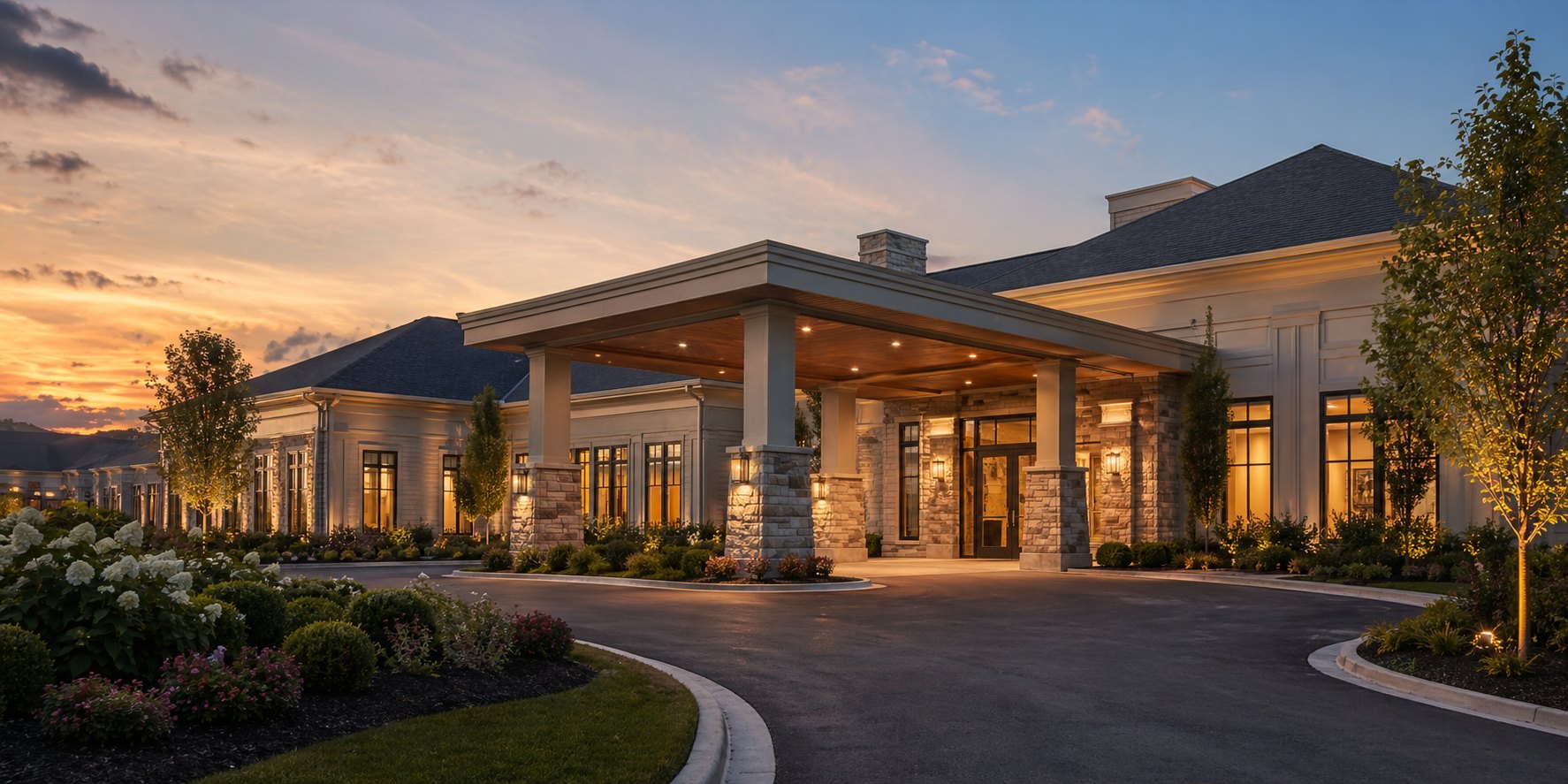
A skilled nursing facility directly across from an acute-care hospital benefits from stronger referrals, easier physician coverage, and faster patient transfers—supporting higher acuity, a better payer mix, and a competitive advantage that nearby facilities struggle to replicate.
Why the first block matters more than the next ten
Distance in post-acute care does not work in a straight line. The difference between being across the street from a hospital and being half a mile away is far larger than the difference between half a mile and three miles. Once a facility is out of sight of the hospital's front door, it becomes one name on a list rather than a place a discharge planner can point to through a window.
Hospital discharge is a time-pressured process. A case manager is working to move a patient out of an acute bed as soon as the patient is clinically ready, and every hour of delay carries cost for the hospital. When a SNF is immediately adjacent, the logistics of that move collapse to almost nothing: a short transport, a family that can walk over and tour the same afternoon, a bed that can be confirmed in person rather than by fax and phone tag. The facility a few blocks away is not clinically inferior. It is simply harder to use on a Tuesday afternoon when the census is full and a bed is needed now.
This is the core of the advantage. Everything else described below follows from the fact that proximity removes friction at the exact moment the referral decision is made.
How proximity changes referral flow and discharge planning
Visibility with the people who make the decision
Referrals to skilled nursing come from a small group of people inside the hospital: case managers, social workers, discharge planners, hospitalists, and the therapy staff who assess whether a patient can go home. Relationships with that group are the single most important driver of a SNF's census. A facility across the street can maintain those relationships in a way a distant competitor cannot. Liaisons walk over. Administrators attend hospital meetings without losing half a day. Staff from the two buildings know each other by name because they eat in the same places.
Family preference is a real referral force
Families choose the facility in most discharge conversations, and they choose under stress, quickly, and usually with limited information. A building they can see from the hospital lobby and visit without arranging transportation has an enormous advantage in that conversation. Spouses who have been sitting in a hospital room for a week will often pick the option that lets them keep the same routine.
Readmissions and the return trip
Proximity cuts both ways in a useful sense. When a resident decompensates, the facility can get that resident evaluated quickly, and in some cases avoid a full readmission through an emergency department visit or a rapid physician assessment. Hospitals watch readmission performance closely, and a post-acute provider that can manage clinical instability quickly because the hospital is across the street is a more attractive discharge partner.
What proximity does to payer mix and clinical acuity
The referrals that come directly out of an acute stay are, by definition, short-stay rehabilitative and skilled patients. That population carries a different reimbursement profile than long-stay custodial residents, and it typically sits at higher acuity. A facility positioned to capture a large share of direct hospital discharges will tend to develop a census weighted toward those short-stay admissions.
That shift has consequences the owner already knows well. Higher acuity requires deeper clinical capability, more therapy capacity, more robust nursing coverage, and tighter length-of-stay management. It also produces higher revenue per patient day and more volatile census, because short-stay patients turn over constantly. A hospital-adjacent SNF that has built the clinical program to handle that population has something genuinely difficult to copy. One that has the location but not the program is leaving the advantage on the table, which is itself a common and identifiable opportunity for a buyer.
Service line alignment
Hospitals concentrate on particular service lines: orthopedics, cardiac care, neurology, general surgery. A SNF across the street can build its clinical program around whatever that specific hospital does most. Orthopedic-heavy discharge volume calls for a different therapy model and different staffing than a cardiac or pulmonary population. This kind of alignment is only practical when the volume from one referral source is large enough to justify it, which is much more likely when the facility is the nearest option.
Staffing, physician coverage and clinical support
Labor is the hardest problem in skilled nursing, and location affects it in several concrete ways.
- Physicians and advanced practice clinicians can cover the SNF between hospital rounds, which makes recruiting and retaining medical direction easier and improves how quickly residents are seen.
- Nurses and therapists who work at or near the hospital have a short commute to a second position or a career move, widening the practical labor pool.
- Specialty services such as wound care, dialysis coordination, imaging and laboratory work are easier and cheaper to arrange when the hospital and its vendors are adjacent.
- Emergency response and transport are faster and less disruptive, which reduces both clinical risk and cost.
None of these eliminates the staffing challenge. They reduce it at the margin, and in an industry where agency use and overtime move the operating margin substantially, marginal relief on labor is meaningful to operating results and to how a buyer projects expenses.
Network positioning, partnerships and preferred provider status
Health systems, managed care plans and accountable care arrangements increasingly narrow the set of post-acute providers they send patients to. Selection into those preferred networks generally depends on measurable performance — length of stay, readmission rates, quality measures, responsiveness — rather than on address. But address influences the outcome. A facility across the street is easier for the system to monitor, easier to integrate into joint care protocols, and easier to hold accountable through direct contact. It also solves the practical problem of keeping patients within the system's geographic footprint.
The relationship carries risk as well, and an honest assessment names it. A SNF that depends heavily on one hospital is exposed to that hospital's decisions: a change in service lines, a merger, the opening of a hospital-owned or joint-ventured post-acute unit, a shift in network strategy, or simply new leadership in case management. Concentration of referral source is a real underwriting consideration, and a sophisticated buyer will ask about it directly. The strongest hospital-adjacent facilities have a documented, institutional relationship rather than one that lives in a single liaison's contact list, and they have secondary referral sources developed alongside the primary one.
How buyers and lenders think about hospital-adjacent skilled nursing
A buyer valuing a SNF works from stabilized net operating income and applies a capitalization rate that reflects the risk of that income stream. Location adjacent to a hospital affects both halves of that calculation.
On the income side, hospital proximity tends to support the elements buyers care most about: occupancy that recovers faster after a disruption, a payer mix weighted toward higher-reimbursement short-stay care, and a referral pipeline that does not require heavy marketing spend to maintain. On the risk side, a defensible referral position lowers the perceived volatility of that income, and a lower perceived risk generally supports a more favorable cap rate than a comparable facility with a diffuse or contested referral base. Lenders look at the same question from the other direction: how durable is the census if one thing goes wrong.
What buyers will test
Proximity is not accepted at face value. Expect a buyer to work through the specifics:
- What share of admissions comes from the adjacent hospital, and how that share has moved over several years.
- Whether the relationship is contractual, documented through a preferred network or transfer arrangement, or informal.
- Whether the hospital operates or is building its own post-acute capacity, or has a competing joint venture.
- How the facility's quality metrics and length-of-stay performance compare to the alternatives the hospital could use.
- Whether the physical plant, unit mix and therapy space actually support the acuity the location delivers.
- What other hospitals, physician groups and managed care plans contribute to the census.
Where the advantage is not being captured
Some hospital-adjacent facilities underperform. An aging physical plant, thin therapy capacity, weak survey history, or a management team that never invested in the hospital relationship can leave a very good location producing ordinary results. From a seller's standpoint that is worth understanding before going to market, because the gap between what the location could produce and what it does produce is exactly what a value-add buyer will price into the offer. It is also, in many cases, fixable, and a period of demonstrated improvement before a sale can change how the asset is received.
Turning location into evidence a buyer can underwrite
An owner who believes location is the facility's principal strength should be prepared to prove it rather than assert it. Referral source data by month over several years, admission volume by discharging physician or service line, length of stay and readmission performance, and any written agreements or network participation documents do more for a valuation conversation than a description of the view from the front door.
It is also worth being candid about the limits of the advantage. A hospital across the street does not overcome a building that cannot accommodate the acuity being referred, a staffing model that cannot maintain census, or a regulatory history that makes the hospital hesitant. Licensing, certification, change-of-ownership approval and any state-specific requirements around bed capacity or transfer agreements vary by jurisdiction and change over time, and they need to be checked against current rules in the relevant state rather than assumed. Location is a strong starting position, and it is most valuable in the hands of an operator, or a buyer, who has built the clinical and operational capacity to use it.
Frequently asked questions
Is being across from a hospital really that different from being a mile away?
Yes, more than the distance suggests. Proximity removes friction at the exact moment a discharge decision is made: families can walk over and tour immediately, transport is trivial, and staff from both buildings interact regularly. A facility a mile away is still competitive, but it participates in the referral conversation as a name on a list rather than as the obvious option in front of everyone.
Does hospital proximity automatically increase what my SNF is worth?
Not automatically. Value comes from stabilized net operating income and the risk profile buyers assign to it. Proximity tends to support both — through payer mix, census stability and lower marketing cost — but only if the facility is actually capturing the referrals. A hospital-adjacent building with weak census, thin therapy capacity or survey problems will be valued on its results, with the location treated as upside a buyer expects to pay less for.
How much of a concern is depending on one hospital for referrals?
It is a legitimate concern and buyers will raise it. Heavy concentration in one referral source exposes the facility to that hospital's strategic decisions, including mergers, service line changes, or the development of its own post-acute capacity. The way to address it is to document the relationship formally where possible and to show that secondary referral sources, physician groups and managed care relationships also contribute meaningfully to census.
What should I gather before a buyer asks about my hospital relationship?
Referral source data broken out by month over several years, admissions by service line or discharging physician, length of stay and readmission performance, and copies of any transfer agreements, preferred provider designations or network participation documents. Buyers underwrite evidence, not description, and having this organized shortens diligence considerably.
Can a hospital-adjacent SNF that is currently underperforming still be sold well?
Yes. A strong location with weak operating results is a recognizable value-add profile, and there are buyers who specifically look for it. The trade-off is that the buyer prices the improvement rather than paying for it, so the seller captures less of the upside. If the issues are fixable and the owner has time, a period of demonstrated improvement before going to market usually changes the range of interest and the terms.
This article is general information about how hospital proximity influences skilled nursing operations and valuation. It is not an appraisal, a broker opinion of value, or legal, tax, regulatory or transaction advice, and licensing and certification requirements vary by state. Any conclusion about a specific facility requires current, property-level review.